
Chasing buzzwords without real strategy will always shorten a website’s lifespan.

For B2B tech firms and their marketing teams, it’s time to start thinking ahead to next year. The question of how to optimize your website and maximize ROI for 2026 is probably top of mind right now. With marketing budgets still tight, it’s important to make the most of your available resources — but how do you know you’re investing in the right technology and functionality, not just to achieve your short-term targets but also to align with long-term business goals?
At Clear Digital, we work with B2B tech companies and marketing organizations of all shapes and sizes. We understand the inclination to opt for what seems like a quicker, easier, or less expensive build that will make your site look shiny on launch day but may not deliver staying power. We also know how costly it can be when short-sightedness necessitates a rebuild, sooner than later. (Spoiler alert: sometimes it’s multiple rebuilds.) The goal, instead, should be to ensure your site remains secure, scalable, and easy-to-evolve through 2026 and beyond.
So, what’s the best way to future-proof your B2B website? The key is to think strategically, get clear on your priorities before we start building, and avoid common pitfalls that result in technical debt. To help you make more informed backend decisions and extend the life of your site, let’s talk about the mistakes we see as developers and how you can steer clear of them by making technical choices that balance today’s realities with long-term adaptability.
Think strategy first, technology second
There’s no one-size-fits-all approach to building a B2B website that will last. Every company has a unique set of needs requiring a unique solution, which is why we start every new project with a strategy session. First, we bring all the stakeholders together to get clear on goals and priorities in our trademark Velocity Workshop. Then, we take those findings into a tech workshop, where we work closely with clients to decide on the best technology for each project.
Some tech stack decisions are driven by specific needs. For example, if you have a single web admin running the show, a streamlined, easy-to-manage CMS with guardrails will make it easier for them to make regular updates. A company with a larger digital team, on the other hand, might require a more modular, compartmentalized setup with deeper integrations. Budget constraints can also play a key role.
When companies are focused on integrating cutting-edge performance, animations, or AI features, we help them evaluate the options and make sure the functionality they think they want will actually deliver value. In some cases, a marketing lead may pre-select the tech stack, which limits how much input we have as developers — and can potentially cause problems further down the line.
The priority balancing act
Competing priorities, including budget, security, compliance, speed, and content management ease, often requires trade-offs. If ADA or EMEA compliance is critical, for example, you may need to dedicate resources that limit advanced animations. If performance and security are at the top of your list, a headless CMS’s performance and security might be worth sacrificing administrative flexibility. Or, if you have a super active content team, you might opt for an integrated page builder to give them more flexibility.
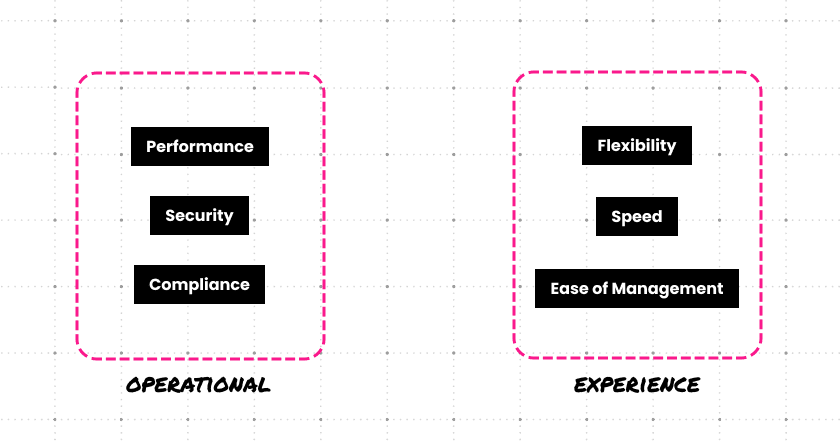
Whatever’s important to you, our job is to guide you through these decisions, designing systems that balance immediate needs with long-term scalability and adaptability. We build resilient, maintainable, and effective B2B websites by tailoring architecture, CMS setups, and third-party tools for each site — and each client’s realities. That’s why at Clear, developers are always involved from the get go.
Innovate for the right reasons
Working in the tech industry, we understand the draw of buzz. When an exciting new tool or solution emerges, lots of folks want to jump on board because it’s cutting-edge and everyone’s talking about it. But that doesn’t necessarily mean it will fit your long-term needs. Chasing buzzwords without real strategy will always shorten a website’s lifespan.
We’ve seen it many times. Clients rush to adopt the latest tech innovation, run it for a few months or a year, then realize that it doesn’t work the way they thought it would. Sometimes, it’s not until we hand the reins over to their website administrators that the shortcomings of their tech choices become clear. By then, the only way to fix the problem is by rebuilding some or all of the backend systems.
At Clear Digital, innovation is always (and only) deliberate. We’re constantly testing emerging tools ourselves so we understand their strengths and weaknesses. That way, we know when to recommend them — and only do so when they solve real problems, scale appropriately, and integrate seamlessly with a client’s goals and resources. For us, it’s important that the benefits of innovation don’t lead to clients being weighed down by unnecessary complexity.
Our approach to AI integration
We’ve always loved keeping our finger on the pulse of technology, and AI is the beating heart of today’s tech landscape. With its ability to enhance both client-facing features and internal workflows, it’s becoming a key component of modern web development. We love finding new ways to implement AI-powered tools on both the front and backend.
Internally, we use AI to spark ideas, accelerate development, and broaden what we can deliver to clients. For example, ChatGPT is transforming our approach to UX research. Integrated development environments with AI integrations like Cursor and Copilot allow us to speed up repetitive coding operations. And code scaffolding platforms like V0, Bolt, and Lovable enable us to quickly prototype UI components and features. For more complex automation workflows, we use n8n — a platform that offers the flexibility of code with no-code speed.
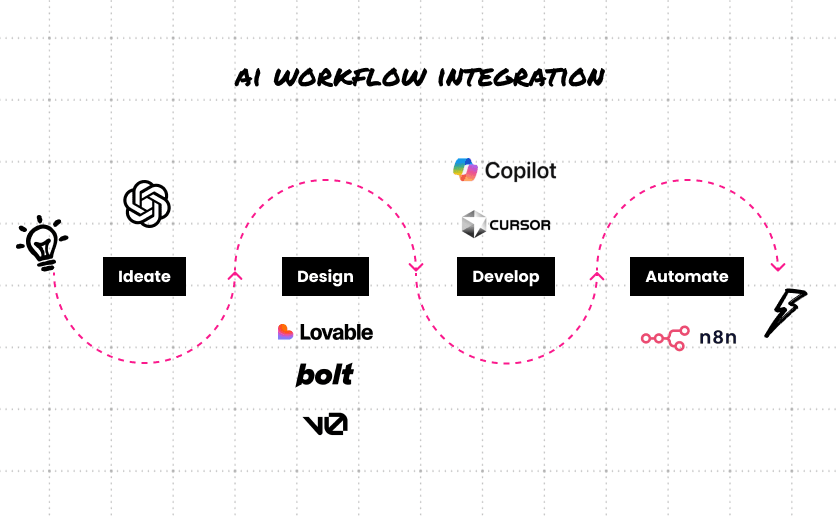
By testing these AI-powered tools ourselves, either on a scratch project or by integrating them into an existing site on a local machine, we’re able to help clients evaluate third-party AI solutions and integrate the best one(s) for their specific needs. We can help you choose the chatbot, personalization engine, or content-generation/SEO tool that will add the most business value, while minimizing future technical debt. Again, it’s all about thinking strategically rather than jumping on the latest bandwagon.
Common pitfalls to keep in mind
No matter how big or small your business, or your budget, it’s important to make realistic decisions. Sometimes we see clients wanting to imitate big names like Apple when they just don’t have the resources to do so. Other times, someone at the top decides the company really needs to invest in a specific type of tech, and no amount of reasoning will change their mind.
Over the last few years, ongoing economic uncertainty has resulted in budget cuts for many companies, with marketing often first on the chopping block. As a result, a less expensive option might be more appealing, but it’s important to consider whether or not it’s strategically sound. High turnover due to budget constraints can also result in organizations lacking anyone who has really “owned” marketing for long enough to see what makes a site effective.
Internal changes can create technical debt, too — for example, if we build a site for a content management team only for that team to be replaced by a single person, suddenly the backend doesn’t work. Realities change all the time, which is why adaptability is key.
All of these pitfalls can be avoided by focusing on strategy first. Figure out your priorities and let the strategy determine the tech, not the other way around.
From the vault: real-world fallout from multiple missteps
A few years ago, we were enlisted to “do a facelift” and take over maintenance for an existing site. At the time, the client was not concerned about backend ease-of-use because developers were the only people touching it. So, the top priorities were dev speed and how the site looked. The backend was not built the way we would recommend, but we did our best to work with the existing components and integrate better solutions, leaving the build fairly technical.
Soon, however, the client decided they needed a dedicated website manager. They hired a new web admin, who quickly realized the backend was too technical for them to work with. Ease-of-use now became the priority. Before we completed the rebuild, through a combination of building and integrating new and existing components and technologies, the client decided it was going to be too costly. Instead, they had us pivot to using a buzzy page builder tool, which was simple enough for the web admin to use.
After investing significant time and money into this second rebuild, the company’s leadership told the web team the site was too heavy — moving the goals again. We tried every trick in the book to improve the site’s speed and performance without changing the tech stack, but in the end the technology just wasn’t aligned to their goals. So, they asked for yet another rebuild, moving the site to a headless CMS with a lighter frontend that was able to hit their performance and security targets.
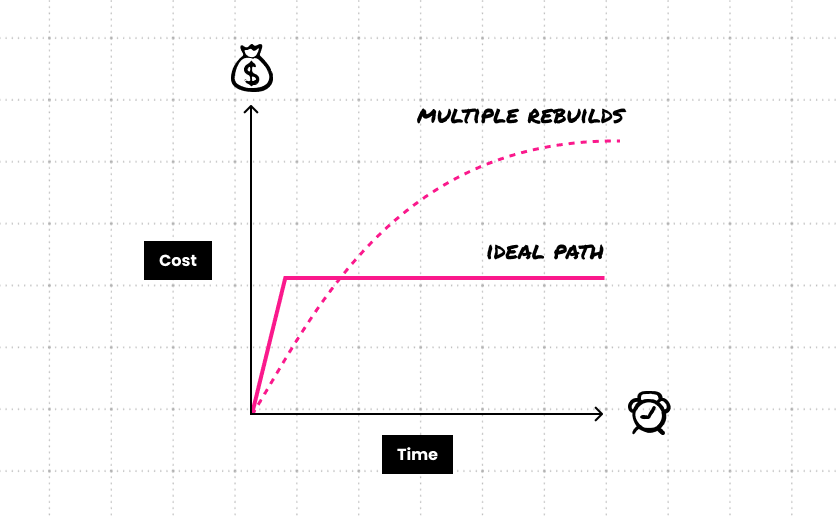
The moral of the story? Investing extra time up front to get clear about what you really want, prioritize your needs, and choose the right tech stack to invest in can save you significant time, effort, and resources. Thinking strategically before getting to work pays off dividends in the end by making the whole process smoother, and making the end result much longer lasting.
Start 2026 with a fresh, future-proof site
The key to building a B2B tech website that will remain scalable, adaptable, and relevant for 2026 and beyond is to get clear about your goals and priorities and partner with a dev team that can tailor the technology to meet those needs with precision and accuracy. Strategy accounts for 80% of success, with tech choices making up the difference.
If you’re in need of a backend rebuild, whether your goal is to improve usability, accelerate performance, or integrate the latest tech trends, Clear Digital is the strategic partner you need. We’ll guide you through the process, help you evaluate options, and tailor systems to your realities. Getting it right is always our priority, and we want you to feel confident that today’s investment won’t become tomorrow’s rebuild. Let’s talk.
Get our latest insights in your inbox
Drupal to WordPress Migration for Healthcare Enterprises: Key Considerations
Article
Drupal to WordPress Migration for Healthcare Enterprises: Key Considerations
By Valod Amirkhanian on March 3, 2026
Read moreManaging Website Technical Debt to Fund Innovation
Article
Managing Website Technical Debt to Fund Innovation
By Valod Amirkhanian on February 21, 2026
Read moreHIPAA Compliant CMS Comparison: Platforms & Hosting
Article
HIPAA Compliant CMS Comparison: Platforms & Hosting
By Valod Amirkhanian on February 19, 2026
Read more